
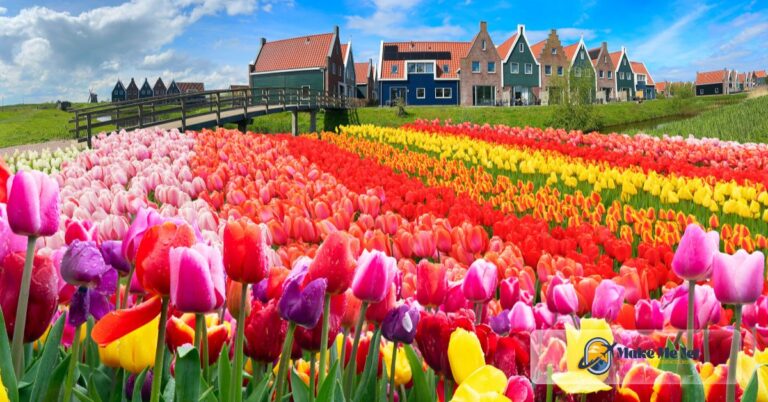
Spring in Europe changes how the same places feel. Cities that seemed grey in winter suddenly open up, parks start filling again, and you can walk for hours without overheating or freezing. It’s also that short window when prices haven’t fully caught up with summer demand, especially if you avoid Easter week.
The obvious headline is the tulips, but if you stop there, you miss half the story. Spring is just as good for smaller cities, wine regions, and coastal towns that are still quiet but fully open. We’ve picked a few places that actually feel different in spring—not just better weather, but a better experience overall.
The Netherlands Beyond the Tulip Fields
Everyone talks about Keukenhof Gardens, and yes, it’s worth seeing once. Rows of tulips, clean paths, and crowds moving slowly between them. It’s organized, photogenic, and a bit predictable.
What works better is using Amsterdam as a base and getting out of the city. Rent a bike or take a short train ride to places like Lisse or Haarlem. You’ll find the same tulip fields, but without fences and timed entries. Some are private, so you can’t walk into them, but even from the road they look better than the curated version.
Back in the city, spring is when canals feel usable again. Outdoor seating returns, and people stop rushing between museums. It’s also one of the easiest times to visit the Rijksmuseum or Van Gogh Museum without planning weeks ahead.
For accommodation, we usually look just outside the canal ring. Prices drop fast once you move 10–15 minutes out, and public transport makes the location less important than it sounds.
Paris Without the Pressure
Paris in summer can feel like a checklist. Spring removes that pressure. You still have queues, but they move faster, and you’re not competing with peak-season crowds.
Parks are the real shift here. Places like the Jardin du Luxembourg and Parc des Buttes-Chaumont go from empty to full in a matter of weeks. People sit, read, and stay longer. It changes how you experience the city.
Food also works better this time of year. Outdoor tables come back, and you can actually enjoy them without sweating through lunch. We’ve had some of our best meals in spring simply because we stayed longer, ordered another glass, and didn’t feel rushed.
If you’re planning to explore beyond the city, this is also a good time for short trips into Champagne or the Loire Valley. Vineyards are just starting to wake up, and tours feel less like a production line.
For guided options, we usually go for smaller food tours or neighborhood walks rather than major attractions. They tend to reflect the slower pace of the season.
Northern Italy Before the Heat Arrives
Spring is arguably the best time for Northern Italy, especially cities like Florence, Milan, and Venice. Summer brings crowds and heat at the same time, which is not a great combination.
In spring, you can walk all day without planning your route around shade. Museums are still busy, but manageable. And evenings are long enough to sit outside without needing a jacket.
Florence works particularly well because it’s compact. You can cover most of it on foot, and the surrounding countryside is easy to reach. The hills of Tuscany start turning green again, and small towns like Siena or Lucca feel active but not overwhelmed.
Venice is more complicated. Spring avoids the worst crowds, but it’s still popular. The trick is timing—early mornings and late evenings are when the city feels closer to how it should.
Accommodation is where planning matters most in Italy. Prices jump quickly, even in spring, especially around weekends.
Barcelona and the Start of Coastal Season
Barcelona in spring sits in that middle zone. It’s warm enough to spend time by the sea, but not yet beach weather for most people. That keeps crowds lower than in summer while still giving you the full experience.
The city itself becomes easier to navigate. You can walk through neighborhoods like El Born or Gràcia without constantly stopping for shade or water. Even longer routes, like from Park Güell down to the coast, feel reasonable.
Food is another reason to visit in spring. Markets are busy again, terraces reopen, and prices haven’t peaked. We’ve noticed that service feels more relaxed compared to summer, when turnover matters more.
Day trips are also easier. Places like Montserrat or coastal towns along the Costa Brava are accessible without the heavy traffic that comes later in the year.
If you’re thinking about mixing city time with beach time, this is where spring works best. You get both, just in smaller doses.
Smaller Cities That Make More Sense in Spring
Some places aren’t built for summer crowds at all. Spring gives them just enough activity without changing their character.
Ljubljana is one of them. It’s small, easy to walk, and centered around the river. In summer, it can feel busy for its size. In spring, it feels balanced.
Seville is another, but timing is everything. Early spring works well, but once temperatures start climbing, it becomes difficult to stay out during the day. If you catch it at the right moment, you get warm evenings, active streets, and manageable heat.
Even parts of Central Europe, like Budapest or Prague, shift in spring. Riverbanks open up, outdoor spaces fill, and the cities feel less like museum pieces and more like places people actually live in.
The pattern is the same across all of them: spring brings back local life before peak tourism reshapes it.
What Actually Matters When Choosing a Spring Destination
The biggest mistake is focusing only on weather. Spring in Europe is unpredictable. You can get sun, rain, or both in the same day.
What matters more is timing around crowds and local activity. Places that rely heavily on summer tourism often feel half-open in early spring. Others, especially major cities, are fully operational year-round and simply become more pleasant.
Price is another factor. Flights and hotels are usually cheaper than summer, but not always. Easter and local holidays can push prices up quickly.
If we had to simplify it, the best spring destinations are the ones where:
- You can walk most of the day without planning around weather
- Outdoor spaces matter (parks, terraces, riversides)
- The place doesn’t rely entirely on peak-season tourism
Everything else is secondary.
What We’d Tell a Friend
Don’t build your trip around one highlight like tulips or a single festival. Those are easy to see, but they don’t define the experience.
Pick a city where you can spend time outside without rushing, add one or two short trips nearby, and leave space in your schedule. Spring rewards slower travel more than any other season in Europe.